
Authors:
Jeremy Nathanael Zefanya, Ahmad Zufar Robbani, Qisha Quarina
Bidang Kajian Microeconomics Dashboard 2025
Executive Summary
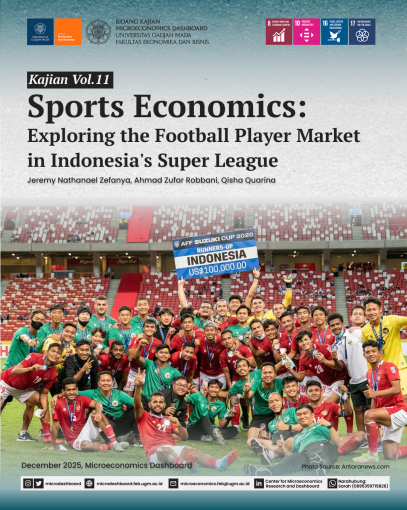
- Indonesia’s Super League has experienced growth, marked by rising fan engagement, increasing club valuations, and expanding recruitment of foreign players. The league operates within a hierarchical football structure that mirrors global labour market patterns, where economic inequality, segmented mobility, and regulatory constraints shape player careers and club strategies.
- This study aims to analyze the economic dynamics of the Indonesian Super League by examining league hierarchy status, regulatory frameworks, and the determinants of market value. It also seeks to contextualize Indonesia’s football labour market within global patterns of player migration and performance-based valuation.
- The analysis reveals a clear financial hierarchy between Super League and Liga 2, with Liga 1 clubs holding significantly larger valuations and stronger institutional capacity. Short-term PKWT contracts expose players to wage risks, making legal protections under Indonesia’s Manpower Law and National Sports System Law crucial for safeguarding workers’ rights.
- Player market value is primarily influenced by performance metrics such as goals and assists, as well as human capital factors including age and position. Younger players and high-performing foreign players, command higher valuations, while age and disciplinary records reduce market value
- Indonesia’s Super League presents a high-opportunity for economic analysis, shaped by financial disparities, uneven contract enforcement, and structural segmentation that influence player valuation and mobility. These conditions highlight the need for further research on wage determination, institutional quality, and how governance and investment patterns shape the broader football labour market
FULL VERSION: Kajian-Vol.11