Universitas Gadjah Mada Bidang Kajian Microeconomics Dashboard
Fakultas Ekonomika dan BIsnis
Universitas Gadjah Mada
  • Beranda
  • SDGs
  • SDGs
Arsip:

SDGs

Kajian Vol.11: Sports Economics: Exploring the Football Player Market in Indonesia’s Super League

Ekonomi PublikEkonomika KeolahragaanEkonomika KetenagakerjaanKajianPublikasi Jumat, 5 Desember 2025

Authors:

Jeremy Nathanael Zefanya, Ahmad Zufar Robbani, Qisha Quarina

Bidang Kajian Microeconomics Dashboard 2025

Executive Summary
  • Indonesia’s Super League has experienced growth, marked by rising fan engagement, increasing club valuations, and expanding recruitment of foreign players. The league operates within a hierarchical football structure that mirrors global labour market patterns, where economic inequality, segmented mobility, and regulatory constraints shape player careers and club strategies.
  • This study aims to analyze the economic dynamics of the Indonesian Super League by examining league hierarchy status, regulatory frameworks, and the determinants of  market value. It also seeks to contextualize Indonesia’s football labour market within global patterns of player migration and performance-based valuation.
  • The analysis reveals a clear financial hierarchy between Super League and Liga 2, with Liga 1 clubs holding significantly larger valuations and stronger institutional capacity. Short-term PKWT contracts expose players to wage risks, making legal protections under Indonesia’s Manpower Law and National Sports System Law crucial for safeguarding workers’ rights. 
  • Player market value is primarily influenced by performance metrics such as goals and assists, as well as human capital factors including age and position. Younger players and high-performing foreign players, command higher valuations, while age and disciplinary records reduce market value
  • Indonesia’s Super League presents a high-opportunity for economic analysis, shaped by financial disparities, uneven contract enforcement, and structural segmentation that influence player valuation and mobility. These conditions highlight the need for further research on wage determination, institutional quality, and how governance and investment patterns shape the broader football labour market
  • read more

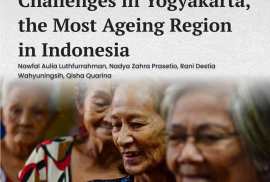
    Monthly Issue: Elderly Trends & Challenges in Yogyakarta, the Most Ageing Region in Indonesia

    Ekonomi PublikEkonomika KependudukanEkonomika KesehatanEkonomika KetenagakerjaanMonthly Issue Kamis, 30 Oktober 2025

    Authors: Nawfal Aulia Luthfurrahman, Nadya Zahra Prasetio, Rani Destia Wahyuningsih, Qisha Quarina

    October 2025

    Yogyakarta stands at the forefront of Indonesia’s ageing era where over 16% of its population is now aged 60 and above.
    Behind this demographic milestone lies a complex picture: many elderly live in poverty, face health vulnerabilities, and lack adequate social protection.

    This issue explores how Yogyakarta’s ageing population challenges economic resilience, public health systems, and social safety nets offering crucial insights into what Indonesia’s future might look like as the nation grows older. read more

    Monthly Issue: Health Economics: Mentally Drop Economically Challenged: Unfolding the Economic Costs of Mental Healthr

    Ekonomi PublikEkonomika KependudukanEkonomika KesehatanEkonomika KetenagakerjaanMonthly Issue Senin, 27 Oktober 2025

    Authors: Rani Destia Wahyuningsih, Qisha Quarina

    October 2025

    Mental health issues do not only affect individuals but also generate major economic consequences. Recent data shows that people from the lowest economic group experience the highest prevalence of mental health disorders, with nearly half of the total societal costs driven by productivity loss.

    How significant is the economic and social burden of mental health today, both globally and in Indonesia?
    Explore the key insights in this month’s infographic. read more

    Kajian Vol.10: Labour Economics – The Vulnerability of Fixed-Term Contract Workers in Indonesia

    Ekonomi PublikEkonomika KependudukanEkonomika KetenagakerjaanKajianPenelitian Senin, 27 Oktober 2025

    Authors:

    Raniah Salsabila, Owen Alberto Liem, Nadya Zahra Prasetio, Nawfal Aulia, Qisha Quarina

    Bidang Kajian Microeconomics Dashboard 2025


    Executive Summary
  • In Indonesia, work agreements are divided into 2 (two), i.e. fixed-term contract (Perjanjian Kerja Waktu Tertentu/PKWT) and indefinite-term contract (Perjanjian Kerja Waktu Tidak Tertentu/PKWTT).
  • The implementing regulations for work agreements are contained in the Law No. 13/2003 on Employment, which was later amended through Law No. 11/2020 on Job Creation or the Omnibus Law, and Government Regulation No. 35/2021.
  • There are differences between the two work agreements, i.e. the length of service, nature of work, employment rights, and employment protection for workers.
  • Despite being eligible to the same social protection programs, fixed-term contract workers are prone to risks due to the limited nature of the work agreement, lack of labour regulations, restricted social program coverage, and susceptibility to income exploitation.
  • Specifically, only a small portion of PKWT workers are covered by employment insurance programs despite being eligible for the programs, indicating the mismatch between regulations and company policies.
  • Demographically, PKWT workers tend to be younger and less educated than the PKWTT workers.
  • The number of workers experiencing termination of employment has increased from year to year with PKWT workers being more vulnerable to termination of employment.
  • In addition, compared to the PKWTT workers, the PKWT workers have a higher percentage of no engagement in the labour union, implying that PKWT workers have a lower incidence of social dialogue in the labour market.
  • Lastly, most PKWT workers lie within the lower income deciles (within the 1st-5th decile), placing them in a financially vulnerable segment of society.
  • read more

    Edisi Khusus Policy Paper Kelas Ekonomika Pembangunan 1 Program Sarjana Population Economics: Efektivitas Kebijakan Kependudukan: Perbandingan Kebijakan Pro-Natalitas di Singapura dan Program Keluarga Berencana di Indonesia

    Ekonomi PublikEkonomika KependudukanEkonomika KesehatanEkonomika PendidikanEkonomika PernikahanKajian Minggu, 28 September 2025

    Penulis: Nadja Madamungga (1)
    Reviewer: Jamilatuzzahro, Qisha Quarina (2), Nawfal Aulia L

    (1) Departemen Ilmu Ekonomi, Fakultas Ekonomika dan Bisnis, Universitas Gadjah Mada;
    (2) Bidang Kajian Microeconomics Dashboard, Fakultas Ekonomika dan Bisnis, Universitas Gadjah Mada

    September 2025

    Highlights:
  • Kajian ini bertujuan menganalisis penyebab rendahnya angka kelahiran dan tingkat fertilitas total (TFR) di Singapura serta mengevaluasi efektivitas kebijakan pro-natalitas yang diterapkan. Selain itu, kajian ini membandingkan kebijakan tersebut dengan program Keluarga Berencana (KB) di Indonesia.
  • Singapura menghadapi penurunan TFR yang signifikan, mencapai angka terendah sepanjang sejarah pada tahun 2023, yaitu 0,97 (Singapore Department of Statistics, 2023). Kondisi ini menimbulkan tantangan serius terhadap regenerasi populasi meskipun telah diberlakukan berbagai insentif pro-natalitas.
  • Sebaliknya, Indonesia masih berfokus pada pengendalian angka kelahiran melalui program KB yang mengutamakan penggunaan alat kontrasepsi untuk menunda kehamilan. Pemerintah Indonesia berupaya menjaga efektivitas program ini di tengah dinamika sosial dan ekonomi yang terus berubah.
  • Regenerasi populasi menjadi variabel penting dalam menghadapi tantangan demografis, baik bagi Singapura yang berusaha meningkatkan angka kelahiran, maupun bagi Indonesia yang menyeimbangkan pertumbuhan penduduk dengan pembangunan berkelanjutan.
  • read more

    Isu Bulanan Bagian 3: Memahami Angka TPT Turun, Benarkah Pasar Kerja Indonesia Membaik?

    Ekonomi PublikEkonomika KependudukanEkonomika KetenagakerjaanMonthly Issue Sabtu, 14 Juni 2025

    Penulis: Qisha Quarina, Owen Alberto Liem

    Juni 2025

    Angka pengangguran terbuka (TPT) Indonesia turun ke 4,76% pada Februari 2025 terendah dalam beberapa tahun terakhir. Sekilas, ini tampak sebagai sinyal membaiknya pasar kerja. Namun jika ditelaah lebih dalam, jumlah penganggur justru meningkat, dan sebagian besar pekerjaan baru yang tercipta adalah pekerjaan informal yang rentan tanpa perlindungan sosial.

    Analisis terbaru kami menunjukkan bahwa 59,4% pekerja Indonesia masih bekerja secara informal, tanpa kontrak kerja formal atau jaminan hukum. Bahkan di kalangan pekerja formal, mayoritas bekerja dengan sistem kontrak jangka pendek (PKWT) yang tidak menjamin keberlanjutan pekerjaan atau akses penuh terhadap jaminan sosial. Cakupan jaminan sosial pun masih sangat rendah, khususnya bagi pekerja informal dan pekerja tanpa perjanjian kerja. read more

    EVENT RECAP – Workshop Policy Paper #1

    Ekonomi PublikEkonomika KependudukanEkonomika KesehatanEkonomika KetenagakerjaanEkonomika PendidikanWorkshop Series Rabu, 14 Mei 2025

    On May 2nd, 2025, we successfully held the first session of our Policy Paper Writing Workshop series, led by Ardina Hasanbasri. The workshop focused on the key aspects of crafting effective policy reports, emphasizing the importance of structuring reports that are clear, concise, and accessible to diverse audiences, including both the public and private sectors.

    Participants were also introduced to the essential components of a well-crafted executive summary—one that presents the main recommendations in a direct and actionable manner. We would like to thank all the participants for their valuable contributions and engagement. We look forward to continuing this journey in future sessions. read more

    EVENT RECAP – Micro-Economica Talks (MET) #1

    Ekonomi PublikEkonomika AgrikulturEkonomika KependudukanEkonomika KesehatanEkonomika KetenagakerjaanEkonomika PendidikanMicro-Economica Talks Selasa, 13 Mei 2025

    [EVENT RECAP – MET Series #1]
    The Center for Microeconomics Research and Dashboard successfully launched the first session of the Micro-Economica Talks (MET) Series, carrying the theme: “Just Transition & Climate Change: The Role of Social Protection and Impacts on Workers.”

    Held over two insightful days: Wednesday, 19 March 2025 and Thursday, 20 March 2025. This event brought together students, researchers, and practitioners to critically explore the intersection of energy transition, climate policy, and social protection. read more

    Monthly Issue Vol.2: Just Energy Transition in Indonesia’s Coal Sector

    Ekonomi PublikEkonomika KependudukanEkonomika KetenagakerjaanEkonomika TeknologiKajianMonthly Issue Kamis, 8 Mei 2025

    Author: Ahmad Zufar Robbani, Raniah Salsabila, Qisha Quarina

    May 2025

    Indonesia’s commitment to achieving net-zero emissions by 2060 or earlier places the coal sector at the heart of the nation’s energy transition. As one of the main contributors to national GDP, state revenue, and employment, phasing out coal is not just an environmental milestone—it’s a socioeconomic turning point. Our latest study reveals that while most coal workers belong to the highest wage deciles, many are still vulnerable due to fixed-term contracts that limit access to social protection. The transition is projected to cause widespread job losses across upstream and downstream industries, with regions like East Kalimantan and South Sumatra likely to face the greatest impact. read more

    Rilis Booklet BISSA

    Ekonomi PublikEkonomika KependudukanEkonomika KesehatanPublikasi Rabu, 30 April 2025

    As a result of collaboration between Microeconomics Dashboard and Spatial Research in Regional & Sustainable Economics (Sparse) Working Group under the Faculty of Economics and Business UGM, BISSA! published a booklet entitled “Mengelola Sampah dengan Baik untuk Menciptakan Lingkungan yang Berkelanjutan”.

    Our booklet is now officially copyrighted and available for access on the Microeconomics Dashboard website!

    This booklet was proudly created by the Community Service Team BISSA!, focusing on sustainable waste management practices in general. Through this initiative, we aim to raise awareness and encourage better waste practices that benefit both the community and the environment. read more

    12

    Berita Terakhir

    • Kajian Vol.11: Sports Economics: Exploring the Football Player Market in Indonesia’s Super League
    • Monthly Issue: Elderly Trends & Challenges in Yogyakarta, the Most Ageing Region in Indonesia
    • Monthly Issue: Health Economics: Mentally Drop Economically Challenged: Unfolding the Economic Costs of Mental Healthr
    • Kajian Vol.10: Labour Economics – The Vulnerability of Fixed-Term Contract Workers in Indonesia
    • Edisi Khusus Policy Paper Kelas Ekonomika Pembangunan 1 Program Sarjana Population Economics: Efektivitas Kebijakan Kependudukan: Perbandingan Kebijakan Pro-Natalitas di Singapura dan Program Keluarga Berencana di Indonesia
    Universitas Gadjah Mada

    Bidang Kajian Microeconomics Dashboard
    Fakultas Ekonomika dan Bisnis
    Universitas Gadjah Mada
    Jln. Sosio Humaniora No.1, Bulaksumur, Yogyakarta, Indonesia 55281
    Phone: 081227556133 – Vika
    Email: microeconomics.feb@ugm.ac.id

    © Bidang Kajian Microeconomics Dashboard

    KEBIJAKAN PRIVASI/PRIVACY POLICY