Universitas Gadjah Mada Bidang Kajian Microeconomics Dashboard
Fakultas Ekonomika dan BIsnis
Universitas Gadjah Mada
  • Beranda
  • SDG 11: Kota dan Pemukiman yang Berkelanjutan
  • SDG 11: Kota dan Pemukiman yang Berkelanjutan
Arsip:

SDG 11: Kota dan Pemukiman yang Berkelanjutan

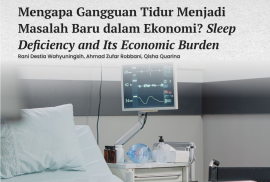
Kajian Vol.13: Health Economics: Mengapa Gangguan Tidur Menjadi Masalah Baru dalam Ekonomi? Sleep Deficiency and Its Economic Burden

Ekonomi PublikEkonomika KependudukanEkonomika KesehatanEkonomika KetenagakerjaanEkonomika PendidikanKajianPublikasi Senin, 29 Desember 2025

Penulis:

Rani Destia Wahyuningsih, Ahmad Zufar Robbani, Qisha Quarina

Bidang Kajian Microeconomics Dashboard 2025

Ringkasan Eksekutif

  • Defisiensi tidur (sleep deficiency) merupakan kondisi ketika individu tidak memperoleh durasi dan/atau kualitas tidur yang memadai, termasuk tidur yang tidak selaras dengan ritme biologis, kualitas tidur yang buruk, serta adanya gangguan tidur.
  • Meskipun sering tidak disadari dan jarang dilaporkan, sleep deficiency telah berkembang menjadi isu kesehatan global dengan implikasi ekonomi yang luas, terutama melalui penurunan produktivitas tenaga kerja dan hilangnya jam kerja.
  • Faktor individu, termasuk rendahnya aktivitas fisik, status gizi overweight atau obesitas, serta kebiasaan merokok, bersama dengan kondisi kesehatan mental, merupakan determinan penting dalam terjadinya sleep deficiency. Selain itu, faktor struktural seperti durasi perjalanan kerja (commuting time) yang panjang turut berkontribusi terhadap berkurangnya waktu tidur.
  • Prevalensi sleep deficiency secara global menunjukkan adanya pola ketimpangan sosial-ekonomi. Kelompok dengan tingkat pendidikan lebih rendah dan individu yang berstatus menganggur cenderung memiliki kualitas tidur yang lebih buruk dibandingkan kelompok lainnya.
  • Secara lintas negara, hanya sekitar separuh orang dewasa dunia yang melaporkan memperoleh tidur yang cukup, dengan Jepang dan Korea Selatan menempati posisi terbawah dalam persentase penduduk yang mendapatkan tidur cukup.
  • Di Indonesia, sleep deficiency menunjukkan bahwa meskipun mayoritas masyarakat menilai kualitas tidurnya berada pada kategori “cukup”. Lebih dari 25 persen individu mengalami kesulitan tidur lebih dari tiga kali dalam seminggu, mengindikasikan adanya masalah tidur yang bersifat berulang.
  • Pengukuran economic costs di negara maju oleh Hafner et al. (2017) melalui pendekatan mikro menilai kerugian produktivitas akibat absenteeism dan presenteeism, dan menemukan adanya hubungan berbentuk U-shaped relationship antara durasi tidur dan produktivitas kerja.
  • Hafner et al. (2017) melalui pendekatan makro menggunakan model keseimbangan umum dinamis berbasis Overlapping Generations (OLG) menemukan bahwa setiap skenario perbaikan durasi tidur secara konsisten meningkatkan produk domestik bruto (PDB).
  • read more

    Monthly Issue: Health Economics: Mentally Drop Economically Challenged: Unfolding the Economic Costs of Mental Healthr

    Ekonomi PublikEkonomika KependudukanEkonomika KesehatanEkonomika KetenagakerjaanMonthly Issue Senin, 27 Oktober 2025

    Authors: Rani Destia Wahyuningsih, Qisha Quarina

    October 2025

    Mental health issues do not only affect individuals but also generate major economic consequences. Recent data shows that people from the lowest economic group experience the highest prevalence of mental health disorders, with nearly half of the total societal costs driven by productivity loss.

    How significant is the economic and social burden of mental health today, both globally and in Indonesia?
    Explore the key insights in this month’s infographic. read more

    Rilis Booklet BISSA

    Ekonomi PublikEkonomika KependudukanEkonomika KesehatanPublikasi Rabu, 30 April 2025

    As a result of collaboration between Microeconomics Dashboard and Spatial Research in Regional & Sustainable Economics (Sparse) Working Group under the Faculty of Economics and Business UGM, BISSA! published a booklet entitled “Mengelola Sampah dengan Baik untuk Menciptakan Lingkungan yang Berkelanjutan”.

    Our booklet is now officially copyrighted and available for access on the Microeconomics Dashboard website!

    This booklet was proudly created by the Community Service Team BISSA!, focusing on sustainable waste management practices in general. Through this initiative, we aim to raise awareness and encourage better waste practices that benefit both the community and the environment. read more
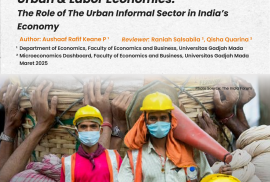
    Special Edition Policy Paper Development Economics Class: Urban & Labor Economics: The Role of The Urban Informal Sector in India’s Economy

    Ekonomi PublikEkonomika KetenagakerjaanKajian Senin, 10 Maret 2025

    Author: Aushaaf Rafif Keane Pribadi (1)
    Reviewer: Raniah Salsabila (2), Qisha Quarina (2)

    Maret 2025

    Highlights:

  • Informal sectors, specifically urban informal sector, play significant roles in the economy and employment of the people in India. 
  • The dominance of the urban informal sector in India is mainly caused by urbanization coupled with premature deindustrialization. 
  • The urban informal sector has a significant role in income generation and unemployment reduction, leading to increased livelihood for the poor. On the other side, the urban informal sector faces challenges, such as low access to credit, production technologies, formal training, and public services. 
  • However, the existence of the urban informal sector still sparks debate on whether it is desired in the economy. The urban informal sector is typically characterized by low productivity, but its vital role as the livelihood of the urban poor and its potential resilience to shocks may benefit India’s current economic condition if treated accordingly. 
  • It is acknowledged that the development of the urban formal sector can stabilize the urban informal sector through balanced transitions and increased productivity from the spillover effects.
  • However, comprehensive policies targeted specifically to the urban informal sector are needed, including facilitation of capacity building, inclusive credit access, accommodative business insurance, and formalization mechanism that is adapted to specific informal sector types. 
  • read more

    Berita Terakhir

    • Kajian Vol.14: Agricultural Economics: The Moderation of Indonesia’s Agricultural Sector: Why Productivity and Growth Are Slowing Down?
    • Kajian Vol.13: Health Economics: Mengapa Gangguan Tidur Menjadi Masalah Baru dalam Ekonomi? Sleep Deficiency and Its Economic Burden
    • Kajian Vol.12: Labour Economics: Indonesia’s Young Labour Force: Trends and Challenges in Youth Unemployment
    • Edisi Khusus Policy Paper Kelas Ekonomika Pembangunan 1 Program Sarjana Population Economics: Analisis Efektivitas Kebijakan Insentif Kelahiran di Tengah Krisis Populasi Korea Selatan
    • Kajian Vol.11: Sports Economics: Exploring the Football Player Market in Indonesia’s Super League
    Universitas Gadjah Mada

    Bidang Kajian Microeconomics Dashboard
    Fakultas Ekonomika dan Bisnis
    Universitas Gadjah Mada
    Jln. Sosio Humaniora No.1, Bulaksumur, Yogyakarta, Indonesia 55281
    Phone: 081227556133 – Vika
    Email: microeconomics.feb@ugm.ac.id

    © Bidang Kajian Microeconomics Dashboard

    KEBIJAKAN PRIVASI/PRIVACY POLICY