
Authors:
Nawfal Aulia Luthfurrahman, Ahmad Zufar Robbani, Qisha Quarina
Bidang Kajian Microeconomics Dashboard 2025
Executive Summary
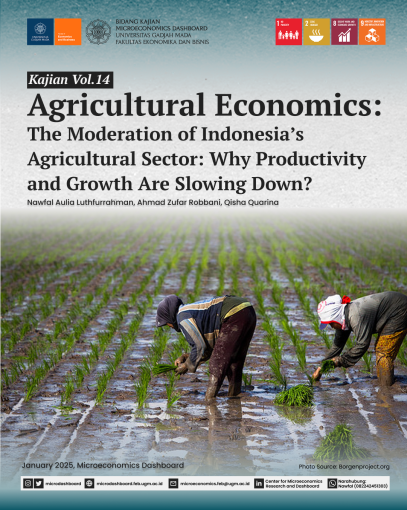
- The agricultural sector in Indonesia remains a vital source of employment and food security but is growing to be typified by stagnation in productivity. Despite the improvement in agricultural value added per worker over time, the growth has been low and has been persistently lower than industry and services.
- One major factor behind this stagnation is the aging structure of the agricultural workforce. A growing share of agricultural workers is above prime working age, while younger generations are steadily leaving the sector. This demographic shift limits labor productivity and slows the adoption of modern technologies and practices.
- Land fragmentation and insecure tenure represent another critical bottleneck. Most agricultural holdings operate on small and fragmented plots, often without formal land ownership. These conditions increase production costs, reduce scale efficiency, restrict access to credit, and discourage long-term investment in productivity-enhancing inputs.
- There is still a significant share of agricultural holdings who are still in subsistence and semi-subsistence farming where farmers produce goods that are mostly consumed in the family or they are not sold in the market. The low productivity and land underutilization is reinforced by this type of production, which restricts income production, capital accumulation, and reinvestment.
- Despite policy efforts to expand access to fertilizers, irrigation, and digital technologies, technology adoption remains uneven. The small area of irrigation covered, the lack of uniformity in the use of inputs, and partial diffusion of modern tools are the reasons why the overall agricultural sector of Indonesia is not changing and slow down the process of agricultural transformation.
FULL VERSION: Kajian Vol.14